How Lunokhod Was Driven
А. Фёдорова28 مارس 2026قراءة في 8 دقيقة
A crew of five in Simferopol, a delayed television image and a speed of two kilometres an hour.
Driving Lunokhod looked like this: five people in a room at the Deep Space Communications Centre near Simferopol, a screen with a black-and-white image in front of them, a joystick and a console. The crew consisted of a commander, a driver, a navigator, a flight engineer and a high-gain antenna operator.
The main difficulty was delay. The radio signal takes about 2.6 seconds to the Moon and back, plus the time to form and transmit a frame. The picture refreshed once every few seconds, so the driver saw not what was happening but what had happened. Real-time control was impossible; they drove in short commands with stops to assess the situation.
Hence the speed — about two kilometres an hour in first gear. In 301 days of operation the rover covered 10 540 metres. For comparison: a walker covers that distance in two hours.
Reading the terrain was a separate task. The television image was flat, shadows were almost absent under a high Sun, and whether the feature ahead was a crater or a mound had to be judged from indirect signs. The navigator dead-reckoned from wheel revolutions and the gyro vertical, while precise position was refined by laser ranging from Earth.
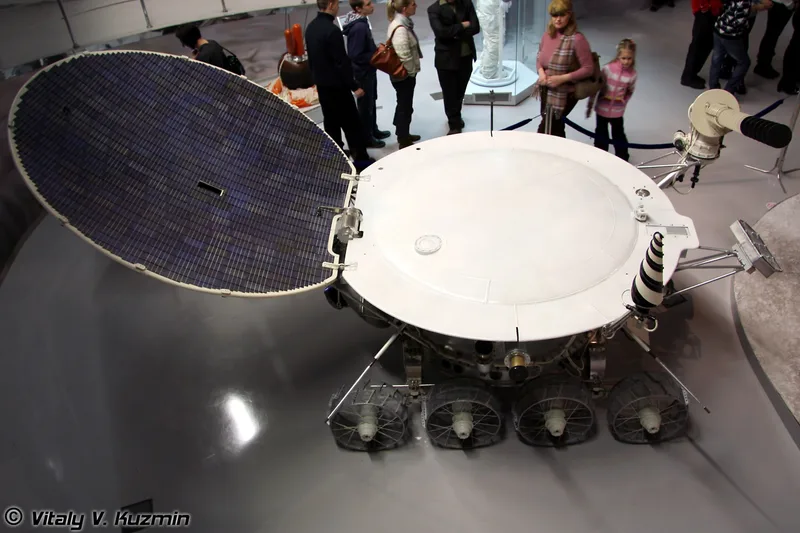
At night, when the Sun set, the lid with its solar array closed and the vehicle went into sleep mode for two Earth weeks. An isotope heat source warmed the electronics: without it, minus 150 degrees would have destroyed everything in the first night.
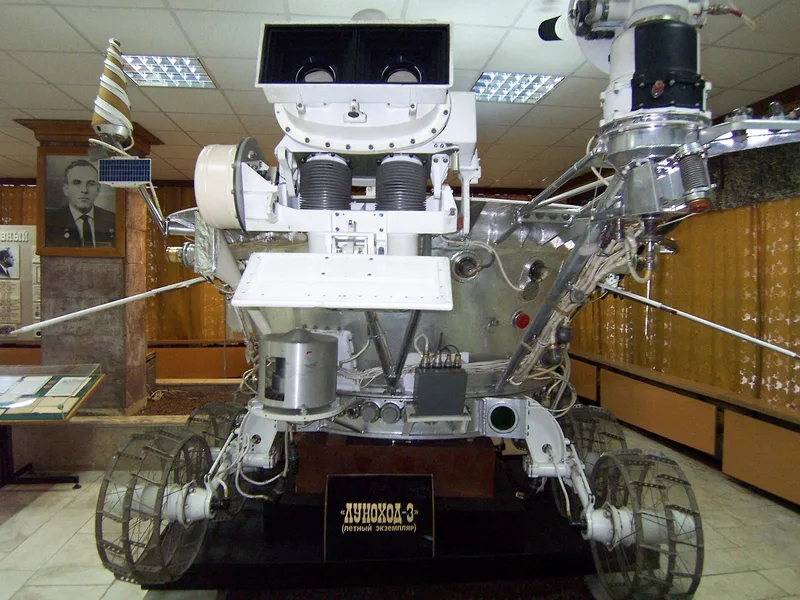
The ground twin of Lunokhod stands in the space hall. It was used on the lunar proving ground — a special range with poured soil and craters, where the crew trained to drive with an artificially introduced signal delay.